


University of Southern Mississippi Athletics
4/18/2024 4:00:00 PM | Baseball
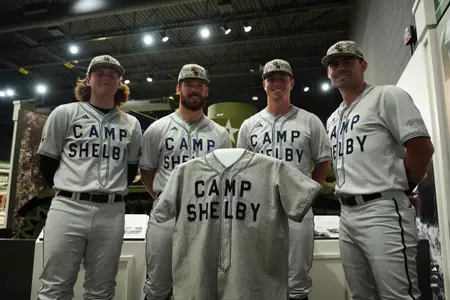
CAMP SHELBY, Miss. – Southern Miss baseball salutes the Camp Shelby All-Stars of World War II by donning commemorative jerseys on Sunday, April 21, as part of the teams Military Appreciation Weekend. Southern Miss Athletics is offering free tickets to Pete Taylor Park/Hill Denson Field for members of the military, both active and retired, and a discounted rate for immediate family members while supplies last for Sunday's game.
"This new jersey that we have recreated thanks to the support of Southern Miss, is designed to honor and remember those important baseball players who served in our military during WWII and also the games that they played to help take our minds off of war for a little while, at a time when our country was involved in the greatest global conflict in history," said Tommy Lofton, Director of the Mississippi Armed Forces Museum. "Eighty years later, we are excited to recreate the jersey as a salute to our service members of the past, but also those of the present."
EVOLUTION OF THE GAME
Baseball. Long known as America's pastime, the sport has stood steadfast throughout the evolution of our nation and often as a window into the American Spirit. As such, the sport—and Hattiesburg—were defined by their efforts during the world wars.
When The University of Southern Mississippi's predecessor, Mississippi Normal College, earned legislative approval on March 30, 1910, its new home of Hattiesburg, Mississippi, had barely established itself along the Gulf South. The formerly sleepy railroad siding town was the hub of a lumber boom in the region, leading to its population rising from 1,172 in 1890 to 11,733. As the lumber industry stabilized, the city and its surrounding communities were looking for new ways to fuel the expansion of their "Hub City."
In 1917, the United States Department of War selected Hattiesburg as the site for a new national army camp. While Hattiesburgers and Mississippians had selected Camp Crawford as the name for their new military installation in honor of local physician Dr. W.W. Crawford, the War Department, keeping with its traditional naming conventions, selected the first governor of the Commonwealth of Kentucky, Isaac Shelby, as the camp's namesake.
Isaac Shelby, a "man whom the folks at Hattiesburg never heard of before" as the Jackson Daily News wrote in 1917, was a hero of the American Revolution and War of 1812. He also served as the first and fifth governor of Kentucky. Shelby's name was selected for the camp as it would be home to future servicemen from Indiana and Kentucky.
Needing distractions from their training and impending deployment, the War Department worked to establish a wide array of athletics and sport events for soldiers, including baseball. Famously at the time, former major leaguer and current manager of the Washington Senators (AL), Clark Griffith, created a national fund to purchase baseball uniforms and equipment for soldiers stationed in training camps. The arrival of Griffith's baseball outfits to Camp Shelby, which was already home to a thriving baseball community, made sure the soldiers had plenty of equipment for their games on the diamond.

Across the country, different military camps like Camp Shelby hosted hundreds of thousands of different athletic competitions though none were more attended than baseball games. In 1918 alone, over 50,000 games of baseball were played in the southeast department with nearly 700,000 men participating and over 2.5 million spectators attending games.
Though the First World War was over, baseball pressed on into the interwar period. Mississippi purchased Camp Shelby and reopened it in 1934 as a national guard and army reserve training center. Each summer, some 25,000 national guardsmen and reserve army units returned to Camp Shelby for exercises, keeping the tradition of excellence of Camp Shelby alive as well as the post's fondness for baseball.
In 1940, the War Department reopened Camp Shelby as a federal installation and used $120,000 of WPA funds to establish permanent improvements at the camp. As part of the peacetime mobilization of 1940 and 1941, two divisions, the 38th Infantry and 37th Infantry of the Ohio National Guard, were stationed at Camp Shelby. When the United States entered the war on Dec. 7, 1941, Camp Shelby was home to over 40,000 soldiers. By the war's end, over 100,000 people worked or lived at Camp Shelby, making it the largest 'city' in Mississippi from 1943-46.

Camp Shelby trained over 750,000 troops for World War II, including the 442nd Regimental Combat Team which consisted of Japanese-American volunteers that became the most decorated unit of its size in Army history. Eight divisions called Camp Shelby home over the course of the second world war.
As these fighting men and women returned to Camp Shelby, so did the game of baseball. The Divisions quickly organized games amongst themselves. With the return of the game, soldiers also created an all-star team that consisted of many current and future major leaguers. The Camp Shelby All-Star team won the 1941 Mississippi Semi-Pro State Title at Hattiesburg's Kamper Park and the 1946 District Title. Camp Shelby was home to many
Some notable pro players stationed at Camp Shelby at one point, or another are:
George Archie (Detroit AL/Washington AL/Saint Louis AL, 1938-41, 46)
Zeke Bonura (Chicago AL/Washington AL/New York NL/Chicago NL, 1934-40)
Al Brazle (Saint Louis NL, 1943, 46-54)
David "Boo" Ferriss (Boston AL, 1945-50)
Al Flair (Boston AL, 1941)
Ken Heintzelman (Pittsburgh NL/Philadelphia NL, 1937-42, 46-52)
George Scharein (Philadelphia NL, 1937-40)
Harry Walker (Saint Louis NL/Philadelphia NL/Chicago NL/Cincinnati NL, 1940-43, 46-55 as player; Saint Louis NL/Pittsburgh NL/Houston NL, 1955-72 as manager)
This list alone includes four All-Star selections, Ferriss (1945, 1946) and Walker (1943, 1947), two World Series pennants, Brazle (1946) and Walker (1942, 1946), an the 1937 National League Batting Title (Walker) and a member of the Boston Red Sox Hall of Fame (Ferriss).
The Camp Shelby All-Star team also played games against other military bases and regional semi-pro teams across Mississippi and Louisiana. Their home games on base and in Hattiesburg were wildly popular affairs for the locals and those traveling with the visitors as well. In fact, Camp Shelby's teams were so popular that they were able to petition the City to improve the dilapidated Kamper Park facilities.
THE UNIFORM
The jerseys which Southern Miss will wear on Sunday are in tribute to these Camp Shelby All-Stars. With two titles under their belts and an even more remarkable service record, the baseballers of Camp Shelby were truly some of the best the United States had to offer.
Baseball was an escape for these men and this weekend Southern Miss, Camp Shelby and the Mississippi Armed Forces Museum look to honor their sacrifices by recreating these uniforms.
As the Golden Eagles take the field on Sunday, let us all remember not only these men and their service, but also the blood, sweat and tears shed by all our nation's veterans and active service members.

The 1946 Camp Shelby All-Stars
"This new jersey that we have recreated thanks to the support of Southern Miss, is designed to honor and remember those important baseball players who served in our military during WWII and also the games that they played to help take our minds off of war for a little while, at a time when our country was involved in the greatest global conflict in history," said Tommy Lofton, Director of the Mississippi Armed Forces Museum. "Eighty years later, we are excited to recreate the jersey as a salute to our service members of the past, but also those of the present."
EVOLUTION OF THE GAME
Baseball. Long known as America's pastime, the sport has stood steadfast throughout the evolution of our nation and often as a window into the American Spirit. As such, the sport—and Hattiesburg—were defined by their efforts during the world wars.
When The University of Southern Mississippi's predecessor, Mississippi Normal College, earned legislative approval on March 30, 1910, its new home of Hattiesburg, Mississippi, had barely established itself along the Gulf South. The formerly sleepy railroad siding town was the hub of a lumber boom in the region, leading to its population rising from 1,172 in 1890 to 11,733. As the lumber industry stabilized, the city and its surrounding communities were looking for new ways to fuel the expansion of their "Hub City."
In 1917, the United States Department of War selected Hattiesburg as the site for a new national army camp. While Hattiesburgers and Mississippians had selected Camp Crawford as the name for their new military installation in honor of local physician Dr. W.W. Crawford, the War Department, keeping with its traditional naming conventions, selected the first governor of the Commonwealth of Kentucky, Isaac Shelby, as the camp's namesake.
Isaac Shelby, a "man whom the folks at Hattiesburg never heard of before" as the Jackson Daily News wrote in 1917, was a hero of the American Revolution and War of 1812. He also served as the first and fifth governor of Kentucky. Shelby's name was selected for the camp as it would be home to future servicemen from Indiana and Kentucky.
Needing distractions from their training and impending deployment, the War Department worked to establish a wide array of athletics and sport events for soldiers, including baseball. Famously at the time, former major leaguer and current manager of the Washington Senators (AL), Clark Griffith, created a national fund to purchase baseball uniforms and equipment for soldiers stationed in training camps. The arrival of Griffith's baseball outfits to Camp Shelby, which was already home to a thriving baseball community, made sure the soldiers had plenty of equipment for their games on the diamond.
The newspaper clipping below is from the Nov. 21, 1917, edition of the Trench and Camp, a newspaper devoted to the goings on at Camp Shelby produced by the New Orleans Item and YMCA.
Across the country, different military camps like Camp Shelby hosted hundreds of thousands of different athletic competitions though none were more attended than baseball games. In 1918 alone, over 50,000 games of baseball were played in the southeast department with nearly 700,000 men participating and over 2.5 million spectators attending games.
Though the First World War was over, baseball pressed on into the interwar period. Mississippi purchased Camp Shelby and reopened it in 1934 as a national guard and army reserve training center. Each summer, some 25,000 national guardsmen and reserve army units returned to Camp Shelby for exercises, keeping the tradition of excellence of Camp Shelby alive as well as the post's fondness for baseball.
In 1940, the War Department reopened Camp Shelby as a federal installation and used $120,000 of WPA funds to establish permanent improvements at the camp. As part of the peacetime mobilization of 1940 and 1941, two divisions, the 38th Infantry and 37th Infantry of the Ohio National Guard, were stationed at Camp Shelby. When the United States entered the war on Dec. 7, 1941, Camp Shelby was home to over 40,000 soldiers. By the war's end, over 100,000 people worked or lived at Camp Shelby, making it the largest 'city' in Mississippi from 1943-46.
President Franklin D. Roosevelt tours Camp Shelby on Sept. 29, 1942, as part of his 1942 Defense Inspection Trip (Sept. 17 – Oct. 1, 1942)
Camp Shelby trained over 750,000 troops for World War II, including the 442nd Regimental Combat Team which consisted of Japanese-American volunteers that became the most decorated unit of its size in Army history. Eight divisions called Camp Shelby home over the course of the second world war.
As these fighting men and women returned to Camp Shelby, so did the game of baseball. The Divisions quickly organized games amongst themselves. With the return of the game, soldiers also created an all-star team that consisted of many current and future major leaguers. The Camp Shelby All-Star team won the 1941 Mississippi Semi-Pro State Title at Hattiesburg's Kamper Park and the 1946 District Title. Camp Shelby was home to many
Some notable pro players stationed at Camp Shelby at one point, or another are:
George Archie (Detroit AL/Washington AL/Saint Louis AL, 1938-41, 46)
Zeke Bonura (Chicago AL/Washington AL/New York NL/Chicago NL, 1934-40)
Al Brazle (Saint Louis NL, 1943, 46-54)
David "Boo" Ferriss (Boston AL, 1945-50)
Al Flair (Boston AL, 1941)
Ken Heintzelman (Pittsburgh NL/Philadelphia NL, 1937-42, 46-52)
George Scharein (Philadelphia NL, 1937-40)
Harry Walker (Saint Louis NL/Philadelphia NL/Chicago NL/Cincinnati NL, 1940-43, 46-55 as player; Saint Louis NL/Pittsburgh NL/Houston NL, 1955-72 as manager)
This list alone includes four All-Star selections, Ferriss (1945, 1946) and Walker (1943, 1947), two World Series pennants, Brazle (1946) and Walker (1942, 1946), an the 1937 National League Batting Title (Walker) and a member of the Boston Red Sox Hall of Fame (Ferriss).
The Camp Shelby All-Star team also played games against other military bases and regional semi-pro teams across Mississippi and Louisiana. Their home games on base and in Hattiesburg were wildly popular affairs for the locals and those traveling with the visitors as well. In fact, Camp Shelby's teams were so popular that they were able to petition the City to improve the dilapidated Kamper Park facilities.
THE UNIFORM
The jerseys which Southern Miss will wear on Sunday are in tribute to these Camp Shelby All-Stars. With two titles under their belts and an even more remarkable service record, the baseballers of Camp Shelby were truly some of the best the United States had to offer.
Baseball was an escape for these men and this weekend Southern Miss, Camp Shelby and the Mississippi Armed Forces Museum look to honor their sacrifices by recreating these uniforms.
As the Golden Eagles take the field on Sunday, let us all remember not only these men and their service, but also the blood, sweat and tears shed by all our nation's veterans and active service members.
The 1946 Camp Shelby All-Stars
– #EverythingMatters | @SouthernMissBSB –



Friday, October 20
Tuesday, August 22
Thursday, August 17
Saturday, August 12