


University of Southern Mississippi Athletics
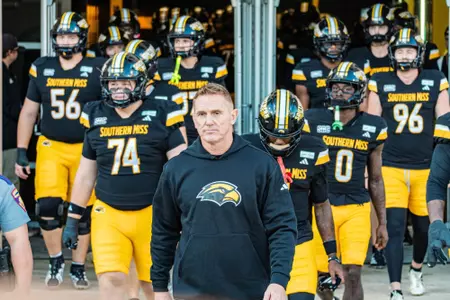
Blake Anderson Weekly News Conference – The Louisiana Game
10/19/2026 1:15:00 PM | Football
HATTIESBURG, Miss. – Southern Miss football coach Blake Anderson addressed the media on Monday, Oct. 19, in the Duff Athletic Center ahead of the Golden Eagles' homecoming contest this Saturday. Game time is set for 4 p.m., at Renasant Stadium.
Southern Miss (1-5 overall, 0-2 Sun Belt) looks to snap a five-game losing streak when they meet the Ragin' Cajuns (5-2, 2-1) in league play.
On the call for the ESPN+ will be Jason Baker (Play-by-Play) and Larry Boyd (Analyst), while the Southern Miss Sports Network's radio pregame show begins at 4:30 p.m. with the Voice of the Golden Eagles, John Cox, analyst Lee Roberts and sideline reporter Bo Morgan on the call.
Fans can still purchase tickets for this contest as well as the other two remaining home game this season by visiting SouthernMiss.com/Tickets.
Here is what Anderson had to say to the media Monday morning:
Opening statement:
"Really, the answer is just too many mistakes. We're still dealing with those, as people can see. The process of growing this team up is frustrating. Everybody is frustrated inside and outside the building, especially the guys who are working hard. I'm beyond proud of the improvements that we made defensively. We played good enough ball to win defensively. We did not create turnovers, though, and we've got to do that. That is a huge piece that we've got to get better at. But watching where they went from a couple weeks ago, especially the Troy game, to where they played Saturday night is encouraging and hopefully something we can build on. The offense did not have a good night. It's obvious we were out of sorts. We did not play well, really, at any position. Maybe with the exception of Steven Robinson, but the boys didn't play well. You combine that with a few mistakes on special teams early, and that puts you in a tough game that we're capable of winning. That's the bottom line. We've got to find a way to stop making undisciplined, immature, inexperienced mistakes, to be truthful, and get all three phases to play their best at the same time. We've seen each phase do well, but not collectively in a game. Until we get all that going together, it's going to be really hard to get the kind of game that we want. We're hoping that comes Saturday against Louisiana. We need it against another really good opponent who's playing well. We've got to get it fixed. The answer is real clear: just go to work and continue to do what we're doing. That's not been the problem. The problem is getting what we're doing in practice, meetings, and walkthroughs consistently to the field, because we're getting tremendous effort and work from these guys. The practices, meetings, and walkthroughs have been really good—phenomenal, even. Getting this group to a point where they're comfortable doing that on game day, when it matters most, and even us as a staff really finding out what that is and what it looks like consistently, is the challenge. We've just got to keep at it, which we will. Hopefully, the product will continue to get better. It has improved, not at the level that we want, but it has improved, and you've seen signs of it. To get a win, we're going to have to get all three phases together, playing like they've played at times. That's the challenge this week."
Q: You've talked about frustrations within coaching meetings—players' meetings. Could you unpack that a little bit—maybe what those conversations look like, and talk about the unity of the team through those tough conversations?
"You've got to give the guys credit. They have continued to come to work and take coaching very well. The energy level they bring, how we've practiced, the approach they've taken, the ownership they've taken—it's not a given when things are not going well. We're a society that wants things to happen quickly, and I get it. We all do. But this is a very difficult process, and we're not the first or the last to go through it. I just feel like those guys have done a great job of trying and continuing to try to give us what we're wanting, even though we're not seeing the immediate, easy response. When you unpack it, it's very simple. We're not trying to beat them up because we are getting effort and attitude. We're trying to coach them through. There's a difference. We're trying to be critical as well from our side and see how we can help them. Simplification is part of it. Routine is part of it. Pushing them through things that are hard is part of it. It takes everything. I think the reason we are seeing even small improvements in areas is because of what the guys are willing to give, and nobody's going to give up on the process. We know the process works. It just takes longer than you want it to. I don't know if that answers your question, but you've got to give the kids a lot of credit, because it would be very easy for us to fracture and point fingers, and that has not happened. Offense versus defense—that has not happened to this point. They've pulled together, which gives us a chance, in my opinion."
Q: After watching the film, breaking down Lyddy, can you talk about maybe some disconnect or coverage issues that you saw?
"There were problems all over on offense. He did not play great. He forced some things, missed a couple, and clearly we can't have turnovers. He's got to protect the ball better. But there were mistakes across the board. We just didn't play well there, uncharacteristic to some degree compared to what we've seen. The timing was off, we were falling off blocks, and we didn't handle movement great up front. Wideouts and quarterback have typically—or I feel like that's a place that we've been pretty consistent, and we weren't. Give them credit. They played a style of defense to try to keep things in front, frustrate us, and not really allow us to push the ball vertically downfield the way we wanted to. We struggled to maneuver underneath that, throw and catch well, and protect well at times when we needed to. The big key for me is he can't put the ball in harm's way, and he did that a couple times. He can't do it, and it doesn't allow us to be what we're able to be if he does that. He knew it, and he was very critical of his performance. Hopefully, we'll see him move beyond that and protect the ball at a better level."
Q: Can you speak to you when you're dealing with that top down kind of deal in game for (Kyle) Cefalo having to like—we need to start working underneath, y'all hit some of those shallow drags and crossers and stuff but maybe just not enough?
"We just didn't create much after they tackled well. We didn't do a good job of creating anything off those. We had a couple other opportunities, vertically, that didn't pan out. We had a couple busts, too. We had some plays that we thought would attack what they were doing defensively, and we just didn't execute them well. We kind of reverted. We just kind of switched places. Last week, the defense couldn't get on the same page. This week, the offense couldn't get on the same page. Very similar frustrations. We're more than capable of playing better than we did, and we did not. We have to play more consistently and eliminate mistakes to play good football."
Q: The game was still in reach the majority of the game but was there ever a thought about QB2 getting a sniff?
"I'm not real fast to fire a guy at that position. I'm not saying that it's not possible at any point, and clearly we've done it in the past, and I've had to. But that's a position where I think you've got to have a little bit of faith and let him work through it. If it was just him, it'd be easier. A lot of times in the heat of the moment, you attribute a problem to what the quarterback did, and then you go back and watch the tape and realize, well, he had a guy in his face, or the wideout didn't break it off. I want to be very careful about making emotional decisions in the heat of the moment unless I'm absolutely certain it was his mistake. A lot of times you go back and watch tape, and things look different. There wasn't a lot of conversation about that at all. I don't want the quarterback playing scared. I want him to play confident, and I want him to play better. He is capable of doing so. John's opportunity is going to come at some point. It could be this season, and y'all have heard me talk about how confident I feel that he's continuing to get better. But I want to be fair to the process and make sure I'm not making an emotional, irrational decision off the wrong information, if that makes sense."
Q: Early on in your film watching process for this week, what do you know about Louisiana—what are they going to do to you?
"I haven't watched a snap of tape on them yet. I've spent every ounce of time I've had since that game was over trying to fix our problems on both sides of the ball and on special teams. I'll move forward to them this afternoon. I've watched them play. I've coached Mike (Desormeaux). Mike played for me. He's family to me. I think he's doing a really good job. He's gone through some tough times there, and what it looks like to me is he's continued to stay true to who he is, retain his roster as much as he can, and grow it up. You're seeing a team that's been together a good bit, and they're playing with some confidence. They're playing old-school, hard-nosed football. It's not flashy. It's just kind of who he is. He's a hard-nosed, old-school football coach. That's the way he was raised and the way he played, and it appears to be working for them. Not perfect, and I'm sure there are a lot of things he'd like to do differently and better. But they're playing for each other. They're trying not to beat themselves, and they're physical. I'd expect to see them come in and stay true to who he is and what's put him in a position to be successful."
Q: (Michael) Desormeaux has been one of the few teams within our conference that's taken that tactic and held on to the majority of both his guys—guys who have been there two and three years. I think that is kind of rare.
"It is rare—I've seen it happen and work, though. Eric Morris was able to be successful at North Texas that way before he left. Obviously, he benefited from a really good quarterback that nobody knew would be that good. Mike's doing the same thing there. I think it's the reason Troy and South are having solid early seasons, too. You look at their rosters; they retained a lot of folks. Retention is going to be a big part of us. This is year one. We inherited a blank slate. We built it quickly. Some of those guys were exceeding our expectations. Others still have more growing up to do. But we didn't miss on a lot of guys. We've got to grow them up. I think retention is going to be a huge piece here. The more we can retain and then build on top of that, it can make a huge impact on where we are a year from now, so we're going to have a challenge in that area. That's going to be a big focus. I just think you look at our league and the teams that seem to be doing the best early: teams that retained well and didn't have to rebuild their entire roster. I think there's real value to letting guys grow up the old-fashioned way. Maybe not to the level it was before, but there are still guys who are going to be better players in our system in year two, year three, if we can get to that point."
Q: You had some official visits this weekend, can you talk about what those were like in the light of the way the season is going?
"You've just got to be transparent and real. We've been honest with these guys. This is starting from scratch, and we need to build. Obviously, we want to go out and try to win games this year, and we're still fighting to do so. We still can. I still believe that we can. We've got to get all three pieces going together. But tell the truth: we need to recruit. This next recruiting class may be the most critical that we'll ever have. What we can retain and what we can put with it is the glue that we're going to build on. If a kid wants an opportunity, and they see that and are realistic in their mind, they can see an opportunity to play. They can feel and see culture—a group that plays hard and plays together. Even though the scoreboard's not reflecting what we want, there are still a lot of other tangible things throughout our program that guys want to be a part of. Obviously, to some degree, we've got to sell the vision of where we want to be. I've done this at two other places. We did this with Larry (Fedora). (Todd) Monken did the same thing. Monken was 0–10 until he won his first game, and then you look up a couple years later and they won a division. This has been done before. We're not the first to do it, and we're probably not the last. Part of it is explaining and being transparent and trying to sell what our vision and our process are, and what we see our future being. It's the same thing I said on day one when I got hired: we're going to play for championships here at some point. I don't know when that's going to happen, but I have zero doubt about the process to get us there. It's the same process that has helped us at every stop. The challenge is a little bit bigger this time because of what we inherited, but it's not impossible. It may look that way to people right now, but it's not impossible. We just have to methodically go through it and not lose faith in it. That's what those guys are hearing from us: the truth. This is where we are. This is where we want to go, and you help us get there. We'll battle like crazy in that area to make this roster better through retention, recruiting, and development."
Q: Kind of off topic—Larry Fedora's first season was in 2008 we played UL—was Dez the quarterback?
"Yes, he was. Dez played for me in '07, when I came and took the job. He had another year left, and yeah, he was. We beat them pretty badly. Obviously, life has changed for everybody since then. I was talking to Larry that day. Larry, called to reach out and I said, 'We were 2–6', and then we rattle off some wins and went to a bowl game. I think we blocked a field goal in overtime against Troy to go 7–6. We were right here in the same kind of circumstance that first year with Larry, and then we built it. Well, we went 7-and-whatever, 7-and-whatever, 8-and-whatever, and then 12–2. I was glancing through things, and Monken went 0–10, then won a game, then 3–9, and then 9–5. This is not the first time Southern Miss or anybody's built like this. We inherited nothing. We started from scratch. We'll get there. It is frustrating, but the guys are doing what we need them to do to continue to get better. There will be a breakthrough at some point. I don't know when. I hope it's soon for their sake, for the fans' sake, and for my sake. There's a process to this, and we can't lose faith in that. I appreciate my AD and my president, and everybody's been super. A lot of people have reached out—a lot of boosters, a lot of close people to the program. "Hey, we got you, man. We're here. We believe in this." And we do, too. Dez was a really good player, and he's a really good ball coach, too. I'm proud to have been a part of his journey."
Players Mentioned



RB
/ FootballMonday, October 19
Sunday, October 18
Monday, October 12
Tuesday, September 29