


University of Southern Mississippi Athletics

Southern Miss Track & Field: A History
5/19/2020 3:34:00 PM | Track & Field/Cross Country
Southern Miss Track & Field: A History
By Madelon Allen, Southern Miss Athletic Communications
In the Southern Miss record book, the men's letterwinners date all the way back to the 1950s, thanks to some archive work from the Voice of the Golden Eagles, John Cox. Back then, there was a track around the football field inside M.M. Roberts Stadium – then called Faulkner Field -where they would compete. The team was extremely successful yet relied mostly on athletes from basketball and football to make up its roster. A Southern Miss athlete himself, Chuck Rohe, would take over the program after he graduated. He was a letterwinner from 1952 to 1953. At one point or another, they moved the track out of the stadium, and the program fell dormant. After it was dissolved, Rohe went on to the University of Tennessee to be a very successful head coach for the Volunteers. Rohe was later named into the Southern Miss M Club Hall of Fame on April 12, 2002.
Enter Marshall Bell, the man hired for the resurrection of the track and field program. Bell, a graduate of Mississippi Vocational College, now Mississippi Valley State, earned his master's from Southern Miss in 1970. He lettered four times at MVSU in track and field and lettered three years in football. He returned to his alma mater after coaching track and football at Hawkins High School and Meridian High School to become an assistant professor in the newly created Department of Coaching and Sports Administration. Then-Athletic Director Roland Dale selected Bell to revive the track and field program. Bell would be responsible for six of the school's 15 varsity sports at the time: men's and women's indoor track, outdoor track, and men's cross country. Beginning with a budget of $25,000 in 1977, they restarted the program and began recruiting. "There is no one way to start a program," said Bell. "It's just the individual and their philosophy for starting from scratch. It was a touch in the dark. We recruited local kids first and athletes that were footballers and basketball players."
He brought in all distance runners to build his roster.
"That's the foundation of a track and field program," remarked Bell. He had only five or six of his runners on scholarship, and he and his team would start competing in the 1979-80 season. Those who are named in the record book as letterwinners from that season are Tim Culliver, Ricky Draper, Nicky Harvey, Gary Herring, Gary Holt, Thomas McGee, Stephen Wash, and Rick Wilcox. Bell recalls that Sammy Winder was also on the roster, becoming a dual-sport athlete after football season was finished.
"The first year, nobody knew anything about the program other than it was me getting it off the ground. It was a tough time, with barely any recruits. We got through the initial start and then started getting recommended about athletes from Alabama, Florida and Louisiana. Those first few years were hit and miss, but we were able to do fairly well in some situations and got through by utilizing the athletes already at USM. I started with distance kids and then a year or two after, I'd pick up some speed people and field people. Getting the name established in the state was the key and being a former high school coach, I already knew many of them. It took a couple of years, and we hired some graduate assistants to aid us."
It wouldn't be long for Bell and his Golden Eagles to start seeing success. Bell attributes it to getting into a conference as early as they did. That was the Metro Conference. According to Bell, being in a conference helped them to make contact with some quality athletes. Donny Young was one of those athletes. "His high school coach was my roommate in college," said Bell. "Getting Donny put us on the map pretty quick. Everyone called him 'Big Money'."
Young still holds the record in the 60-yard dash and the 300-yard dash for indoor, but McKinely West defeated his 100m outdoor record in 2018. He was named to the M Club Hall of Fame on April 7, 2000; the first member of the track and field programs to be inducted.
Having Young helped Bell pick up David Schexnayder, who would become a memorable name for the Golden Eagles. "Distance wasn't very popular in Mississippi," remarked Bell. "We'd place in the top-10 all over. He was going to beat them. Schexnayder helped solidify the distance area of the program." The 880-yard run, the 1500m run, and the mile records all still bear his name. "Schexnayder was able to do things that kids here couldn't do. We made a name early in the conference in track and field."
Come the 1985-86 season, a women's team was added into the mix. "We were making a niche for ourselves," remembers Bell. He would start out with around just five women. Marie Ishee, Michelle McRaney, Paula Pugh, and Melanie Roberts stand out to Bell as being the first ones on his squad. The quality of the athletes he recruited would continue to go up on the men's and women's sides for Coach Bell, and so would his athletes' results. "We've had success in about every area of the program since then," says Bell. "We didn't have a national name in track and field, but we had some winners that competed against the greats."
Kenny Glenn was another one of those greats. He still holds the record for the 55m dash, as well as the 200m outdoor. He was a two-time NCAA Indoor All-American for the 55m in 1988 and 1989. At last, the Golden Eagles would win a championship, solidifying the hours Bell spent building the program. The 1992 men's squad would win the Metro Conference Championships, and they'd do it back-to-back in 1993. The women would pick up a Metro Conference title in 1993.
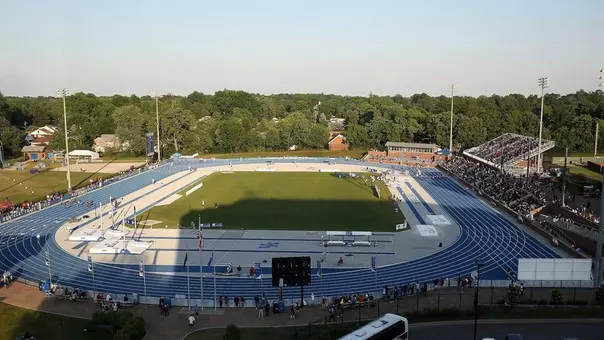
After 18 years at the helm, Coach Bell got a new facility for his tracksters. In the spring of 1997, the Southern Miss Track and Field Complex was opened and put to use just off the Southern Miss campus. The Golden Eagles would host their first two outdoor meets for the modern history of the program that year and hosted the second-ever Conference USA Outdoor Championships.
"Like a proud father, Bell said of that day, "I don't think I have ever had a more satisfying day in my professional career than the day we hosted our first meet in the new facility." The culmination of many hours of planning and hard work had come to fruition as the long-time dream Bell had for the program came true. It took longer than Bell would have liked to achieve many of his other dreams and goals he had for the program, but his philosophy was always 'to dwell on the positives'."
- John Cox's Induction Speech for Marshall Bell into the M Club Hall of Fame
The venue now bears his name as the Marshall Bell Track & Field and Soccer Complex. Bell retired after that season. "I'm different than other coaches," says Bell of his time. "I was in the right places at the right time. I've won 34 State Championships as a high school coach and I started a college program from scratch. I've had the chance to see some of the best athletes in the track and field world at the Olympics and National Championships." Bell spoke of how his grandson is named after him. "He talks about me like I'm a legend, but I was placed here. All the pieces just came together. All that plays a role."
Southern Miss then welcomed just its second head coach of the modern era in the 1997-98 season in Wayne Williams. Williams hailed from Tuscaloosa, Ala., where he had been the assistant coach at the University of Alabama for 21 years. Athletic Director Bill McClellan brought him in for an interview and offered him the head coaching gig on the spot. "I stayed with McClellan at his house for the first month," Williams said of his transplantation to Hattiesburg. Not long after, Coach Williams would bring in James Blackwood as his assistant coach. Blackwood came from the University of Texas after 23 years and a short stint of working with the Houston Astros. They became roommates for that first season while their wives were still away in their respective former homes. "We stayed up from dawn 'til dusk working on the program, wanting to elevate it," said Williams.
He would find some help in Greg Stringer, a former Golden Eagle who competed for Marshall Bell. "I competed for Coach Bell for two years after transferring in the Spring of '92; I started out at Hinds Community College," said Stringer. Stringer was a decathlete who was a part of the Metro Conference Champion team in 1993, lettering in both 1993 and 1994, and then became a student assistant for Bell. His favorite memory of being a student athlete was being a part of that Championship team, and that he contributed six points to that win. After graduating, he moved away for two years but stayed in touch with his coach. "He told me if I ever wanted to come back for graduate school, he'd offer me an assistantship. Well, the fall of '97 I decided to quit my job and come back to graduate school, and I get there, and Coach Bell has retired, and Coach Williams was there," chuckles Stringer. Williams welcomed Stringer on as his graduate assistant.
Just as any coach does after taking a new job, it was time to make the program his own.
"We started making some cuts and bringing in some of our own people, which is something every athletic department has to do when a new coach comes in. We were building it back up again." Both from big-time programs, Williams and Blackwood did what Williams considered "some heavy, hard-time recruiting that James and I both knew how to do." They were well-versed in bringing in NCAA DI caliber athletes. "At the end of that first year, we started bringing them in, and at the end of that second year, we were putting some pretty good teams together," said Williams.
"We moved the team up into a higher level and built off of the success of Coach Bell. He had some really top-notch athletes that were NCAA caliber athletes." Williams spoke of Jason Wilson, a decathlete, and Hellena Wrappah, a sprinter, both who he had recruited at Alabama but steered to the Hub City. Wilson ended up as an All-American for Williams in 2000 in the outdoor decathlon and still holds the school record. Wrappah won the Conference Indoor Champion title for the 200m in 1999, and then the 100m and 200m in 2000. She'd also win the 200m in both 1999 and 2000 outdoor for C-USA. Wenston Riley was recruited from Hinds Community College and would end up an Outdoor NCAA All-American in 2000 and 2001 in the 110m hurdles. "Those were some of the early ones we brought in," said Williams. The list of Conference Champions and NCAA competitors would continue for Williams throughout his tenure, including Vincent Tanui, Tanika Liburd, and Cornelius Duncan who "turned the conference upside down" according to Williams, and still holds the school record for the indoor 400m today.
One of Williams' favorite memories comes from his second season at the helm in 1998-99. "We were at the Indoor Conference Championships at Houston. The season before, we had finished last. We kept battling and the men finished in second place. We went from having 30 and a half points to having 101. It felt like the program began to come back and that we were there." In the 1999-2000 season, Williams' Golden Eagles made considerable strides, and for that, Williams would be named Women's Outdoor Coach of the Year for Conference USA, and NCAA Region 9 Coach of the Year.
In the fall of 1999, Williams would promote Greg Stringer to a full-time assistant, filling the void as James Blackwood left to be an assistant at UTSA. In the spring of 2001, Williams would bring on Kevin Stephen as his new graduate assistant. Stephen, a decathlete from Trinidad and Tobago, competed for Williams at Alabama, but helped out with the program in lieu of running after his freshman season. After his junior year, he'd find himself at Southern Miss with Williams.
During his tenure, Williams' Golden Eagles would turn the record book upside down. "We broke almost every record in the book except for Kenny Glenn's," said Williams. His 2005 Golden Eagle women would place second in the Conference Championships with five first-place finishers, after finishing in fourth in 2004 and 12th in 2003. "They had a phenomenal performance," recounts Williams. "We won second place being just 10 or 12 points away from the first-place spot." They had women win across the board in that Championship, with a distance runner in Dijana Kojic in the 800m, a hurdler in Raquel Washington in the 100m hurdles, Krista Miller in the high jump, Aaliyah Shareef in the triple jump, and Hana Prudilova in the javelin.
As they were seeing their building up of the program see fruit, they were also battling some setbacks. Scholarships were downsized by the athletic department for both the men's and women's teams, effectively ending the men's cross country team and putting the men's indoor squad on hold. "The men's program was on the rise when they cut it," recalls Greg Stringer. "We needed to exist." From then on out, Williams just wanted to keep his team going. "I was concerned with where [the program] would be headed," Williams said. "We just wanted to keep the program afloat after the cuts; we were handicapped. But we were beginning to lose ground, and it wasn't producing like it had been. I didn't want it to be average." So, after 10 years wearing the Black and Gold, Williams would hang up his hat and bid adieu to the Golden Eagles after the conclusion of the 2007 spring season. Overall, Williams produced eight NCAA All-Americans, 52 Conference USA Champions, and broke some 80 school records over 10 years.
After eight years as an assistant, Kevin Stephen would be promoted into the head coaching slot. "Kevin was business-like", remarked Williams. "I felt comfortable being the head and I think the athletic department agreed."
Stringer would stay on one more season with his alma mater. That 2007-08 season is when Greg Stringer would reel in one of the best female track and field athletes that South Mississippi has seen: Tori Bowie. "I first saw her as a 10th grader," recalls Stringer. "She came on a visit her senior year and I knew she was something special; I had to seal the deal." And so he did, but he didn't get the chance to see her as an athlete of his own. "It was heartbreaking to leave, we had a great group of girls. They were ranked No. 10 nationally. I lost a lot of sleep over it." Stringer had become an excellent recruiter for Southern Miss, as he wore the Black and Gold as an athlete himself. "It's the people, it's the size, the southern hospitality," he said. "It's all I knew, and I had no other reference. Southern Miss is well known. They aren't always going to win, but they will always have a presence." One of Stringer's favorite stories to tell recruits was about Crystal Greer, an athlete that was from New York that they recruited. "I told her to just come have a look and she did. After she graduated, she stayed in Hattiesburg for seven years. We focused mostly on local and regional recruiting; keeping talent at home. But I found you've got to be genuine; find the truth and vouch for it."
Kevin Stephen would see success during his seven year turn at the helm of the program. He personally coached one NCAA Champion, along with one runner-up and an NCAA individual event record holder. Overall, his team produced three NCAA champions in his last three seasons. He mentored six NCAA All-Americans – four of whom were First Team selections and two Second Team – as well as had 34 NCAA qualifiers. Overall, the team would see 13 All-Americans in his last three years. During his time, he saw 18 C-USA Champions in 13 different events, and three C-USA meet record holders. Sixty-five All-Conference selections were made during his time, as well as two C-USA performers of the meet. His athletes had 24 school records posted, which included every multi and throwing events. His last three seasons saw Top-15 NCAA team finishes and were the only C-USA program to contribute points toward the Capital One Cup in 2011. Stephen would step down after seven years as the Head Coach and 15 as a member of the Golden Eagle staff at the end of the 2012-13 season.
Jon Stuart was the man for the job. After 15 seasons of coaching at his alma mater, the University of Georgia, the Golden Eagles would bring in their fourth head coach for the 2014-15 season. A 20-year veteran of coaching track and field, Stuart and his Golden Eagles didn't wait long to start seeing successes. In his first season with Southern Miss, Stuart oversaw the men's team scoring its first points at the NCAA Championships since 2004, and the women climbed to a sixth-place finish at the C-USA Championships. His Golden Eagles attacked the record books, replacing the men's indoor 200m, 4x400m relay, women's 4x400m relay, and 400m records, as well as the women's outdoor 400m, mile, distance medley relay, weight throw, and the men's javelin. Eight athletes qualified for the first round of the NCAA Championships in the East Regional, and three would advance to the NCAA Championships.
The successes continue to roll in for Stuart and his Golden Eagles, as they have had school-best finishes at the C-USA Cross Country Championships, broken multiple school records, and had an Olympian in the 2016 Rio de Janeiro games in Mariam Kromah. Overall, Stuart has had 10 First Team NCAA All-Americans, four Second Team NCAA All-Americans, and six earning Honorable Mention. He has had 37 C-USA Individual Champions, 21 NCAA Qualifiers, eight C-USA meet records broken, and one C-USA Women's Outdoor Championship title. He earned C-USA's Women's Coach of the Year in 2018.
Where are they now?
Coach Marshall Bell still resides with his wife in Hattiesburg. Wayne Williams also resides in Hattiesburg, and has been working for PCS ever since he retired from Southern Miss as the Cross Country and Track and Field Coach. He was set to retire from coaching at the end of this high school track season, amassing 56 years of experience in the profession overall. Kevin Stephen is now working in Dallas at a corporate job. Greg Stringer lives in Alabama with his wife and kids, where he is serving as an assistant coach at Auburn. He is in his fourth year at Auburn after working at Ole Miss.
Wayne Williams
"Coach Stuart has done an outstanding job with the program," said Williams. "Absolutely marvelous. I've known Jon for a while and Athletic Director Bill McGillis used me as a resource for the hiring, and he validated my decision in going with him."
Greg Stringer
Stringer has fond memories of his time at his alma mater. "Hats off to Coach Bell," he said. "He was a one man show, and he helped me be a coach. He was so short staffed, so we helped coach each other." He credits Wayne Williams for putting Southern Miss on the map and molding him into the coach he is today. "We went from being 11th in conference to being in second place. Coach Williams showed me the rigor and tenacity of recruiting. He molded me." When asked about his favorite coaching memory, it was just that he was proud of how his jumps athletes would compete. "Jumps always starts the meet, they always fought and clawed; they always started it rolling." Along with that, he was proud to have NCAA competing athletes. He pointed to Cedric Norman, a high jumper, who held the school record for indoor for 15 seasons until Eric Richards came along in 2019. He still holds the outdoor school record, is a two-time NCAA Outdoor All-American, placing third in 2003, and an Indoor All-American in 2004. "It's a thing to stick your chest out about," said Stringer. He would leave Southern Miss after the 2007-08 season, after spending 10 years with his alma mater.
Jon Stuart
"Marshall Bell revived the program, and he did it without a facility," said Stuart. "He kept it going at a high level with little to no recourses. He did a phenomenal job with what he had and a lot of elbow grease. Coach Bell has given me good advice on things he has done, on how to operate, and what could work for us. He's given me strategies to employ to get kids from Mississippi interested in our program. Wayne Williams took it to new levels. They had the new track and a new coach and did new things. He built upon the successes of Coach Bell and it's continued to get better ever since. We've rejuvenated what we've had the past few seasons, and it is exciting to see where we are headed. It's unfortunate the reunion didn't happen this year, but I am looking forward to still connecting with former alumni, to hearing the stories and learning from them."
By Madelon Allen, Southern Miss Athletic Communications
In the Southern Miss record book, the men's letterwinners date all the way back to the 1950s, thanks to some archive work from the Voice of the Golden Eagles, John Cox. Back then, there was a track around the football field inside M.M. Roberts Stadium – then called Faulkner Field -where they would compete. The team was extremely successful yet relied mostly on athletes from basketball and football to make up its roster. A Southern Miss athlete himself, Chuck Rohe, would take over the program after he graduated. He was a letterwinner from 1952 to 1953. At one point or another, they moved the track out of the stadium, and the program fell dormant. After it was dissolved, Rohe went on to the University of Tennessee to be a very successful head coach for the Volunteers. Rohe was later named into the Southern Miss M Club Hall of Fame on April 12, 2002.
Enter Marshall Bell, the man hired for the resurrection of the track and field program. Bell, a graduate of Mississippi Vocational College, now Mississippi Valley State, earned his master's from Southern Miss in 1970. He lettered four times at MVSU in track and field and lettered three years in football. He returned to his alma mater after coaching track and football at Hawkins High School and Meridian High School to become an assistant professor in the newly created Department of Coaching and Sports Administration. Then-Athletic Director Roland Dale selected Bell to revive the track and field program. Bell would be responsible for six of the school's 15 varsity sports at the time: men's and women's indoor track, outdoor track, and men's cross country. Beginning with a budget of $25,000 in 1977, they restarted the program and began recruiting. "There is no one way to start a program," said Bell. "It's just the individual and their philosophy for starting from scratch. It was a touch in the dark. We recruited local kids first and athletes that were footballers and basketball players."
He brought in all distance runners to build his roster.
"That's the foundation of a track and field program," remarked Bell. He had only five or six of his runners on scholarship, and he and his team would start competing in the 1979-80 season. Those who are named in the record book as letterwinners from that season are Tim Culliver, Ricky Draper, Nicky Harvey, Gary Herring, Gary Holt, Thomas McGee, Stephen Wash, and Rick Wilcox. Bell recalls that Sammy Winder was also on the roster, becoming a dual-sport athlete after football season was finished.
"The first year, nobody knew anything about the program other than it was me getting it off the ground. It was a tough time, with barely any recruits. We got through the initial start and then started getting recommended about athletes from Alabama, Florida and Louisiana. Those first few years were hit and miss, but we were able to do fairly well in some situations and got through by utilizing the athletes already at USM. I started with distance kids and then a year or two after, I'd pick up some speed people and field people. Getting the name established in the state was the key and being a former high school coach, I already knew many of them. It took a couple of years, and we hired some graduate assistants to aid us."
It wouldn't be long for Bell and his Golden Eagles to start seeing success. Bell attributes it to getting into a conference as early as they did. That was the Metro Conference. According to Bell, being in a conference helped them to make contact with some quality athletes. Donny Young was one of those athletes. "His high school coach was my roommate in college," said Bell. "Getting Donny put us on the map pretty quick. Everyone called him 'Big Money'."
Young still holds the record in the 60-yard dash and the 300-yard dash for indoor, but McKinely West defeated his 100m outdoor record in 2018. He was named to the M Club Hall of Fame on April 7, 2000; the first member of the track and field programs to be inducted.
Having Young helped Bell pick up David Schexnayder, who would become a memorable name for the Golden Eagles. "Distance wasn't very popular in Mississippi," remarked Bell. "We'd place in the top-10 all over. He was going to beat them. Schexnayder helped solidify the distance area of the program." The 880-yard run, the 1500m run, and the mile records all still bear his name. "Schexnayder was able to do things that kids here couldn't do. We made a name early in the conference in track and field."
Come the 1985-86 season, a women's team was added into the mix. "We were making a niche for ourselves," remembers Bell. He would start out with around just five women. Marie Ishee, Michelle McRaney, Paula Pugh, and Melanie Roberts stand out to Bell as being the first ones on his squad. The quality of the athletes he recruited would continue to go up on the men's and women's sides for Coach Bell, and so would his athletes' results. "We've had success in about every area of the program since then," says Bell. "We didn't have a national name in track and field, but we had some winners that competed against the greats."
Kenny Glenn was another one of those greats. He still holds the record for the 55m dash, as well as the 200m outdoor. He was a two-time NCAA Indoor All-American for the 55m in 1988 and 1989. At last, the Golden Eagles would win a championship, solidifying the hours Bell spent building the program. The 1992 men's squad would win the Metro Conference Championships, and they'd do it back-to-back in 1993. The women would pick up a Metro Conference title in 1993.
After 18 years at the helm, Coach Bell got a new facility for his tracksters. In the spring of 1997, the Southern Miss Track and Field Complex was opened and put to use just off the Southern Miss campus. The Golden Eagles would host their first two outdoor meets for the modern history of the program that year and hosted the second-ever Conference USA Outdoor Championships.
"Like a proud father, Bell said of that day, "I don't think I have ever had a more satisfying day in my professional career than the day we hosted our first meet in the new facility." The culmination of many hours of planning and hard work had come to fruition as the long-time dream Bell had for the program came true. It took longer than Bell would have liked to achieve many of his other dreams and goals he had for the program, but his philosophy was always 'to dwell on the positives'."
- John Cox's Induction Speech for Marshall Bell into the M Club Hall of Fame
The venue now bears his name as the Marshall Bell Track & Field and Soccer Complex. Bell retired after that season. "I'm different than other coaches," says Bell of his time. "I was in the right places at the right time. I've won 34 State Championships as a high school coach and I started a college program from scratch. I've had the chance to see some of the best athletes in the track and field world at the Olympics and National Championships." Bell spoke of how his grandson is named after him. "He talks about me like I'm a legend, but I was placed here. All the pieces just came together. All that plays a role."
Southern Miss then welcomed just its second head coach of the modern era in the 1997-98 season in Wayne Williams. Williams hailed from Tuscaloosa, Ala., where he had been the assistant coach at the University of Alabama for 21 years. Athletic Director Bill McClellan brought him in for an interview and offered him the head coaching gig on the spot. "I stayed with McClellan at his house for the first month," Williams said of his transplantation to Hattiesburg. Not long after, Coach Williams would bring in James Blackwood as his assistant coach. Blackwood came from the University of Texas after 23 years and a short stint of working with the Houston Astros. They became roommates for that first season while their wives were still away in their respective former homes. "We stayed up from dawn 'til dusk working on the program, wanting to elevate it," said Williams.
He would find some help in Greg Stringer, a former Golden Eagle who competed for Marshall Bell. "I competed for Coach Bell for two years after transferring in the Spring of '92; I started out at Hinds Community College," said Stringer. Stringer was a decathlete who was a part of the Metro Conference Champion team in 1993, lettering in both 1993 and 1994, and then became a student assistant for Bell. His favorite memory of being a student athlete was being a part of that Championship team, and that he contributed six points to that win. After graduating, he moved away for two years but stayed in touch with his coach. "He told me if I ever wanted to come back for graduate school, he'd offer me an assistantship. Well, the fall of '97 I decided to quit my job and come back to graduate school, and I get there, and Coach Bell has retired, and Coach Williams was there," chuckles Stringer. Williams welcomed Stringer on as his graduate assistant.
Just as any coach does after taking a new job, it was time to make the program his own.
"We started making some cuts and bringing in some of our own people, which is something every athletic department has to do when a new coach comes in. We were building it back up again." Both from big-time programs, Williams and Blackwood did what Williams considered "some heavy, hard-time recruiting that James and I both knew how to do." They were well-versed in bringing in NCAA DI caliber athletes. "At the end of that first year, we started bringing them in, and at the end of that second year, we were putting some pretty good teams together," said Williams.
"We moved the team up into a higher level and built off of the success of Coach Bell. He had some really top-notch athletes that were NCAA caliber athletes." Williams spoke of Jason Wilson, a decathlete, and Hellena Wrappah, a sprinter, both who he had recruited at Alabama but steered to the Hub City. Wilson ended up as an All-American for Williams in 2000 in the outdoor decathlon and still holds the school record. Wrappah won the Conference Indoor Champion title for the 200m in 1999, and then the 100m and 200m in 2000. She'd also win the 200m in both 1999 and 2000 outdoor for C-USA. Wenston Riley was recruited from Hinds Community College and would end up an Outdoor NCAA All-American in 2000 and 2001 in the 110m hurdles. "Those were some of the early ones we brought in," said Williams. The list of Conference Champions and NCAA competitors would continue for Williams throughout his tenure, including Vincent Tanui, Tanika Liburd, and Cornelius Duncan who "turned the conference upside down" according to Williams, and still holds the school record for the indoor 400m today.
One of Williams' favorite memories comes from his second season at the helm in 1998-99. "We were at the Indoor Conference Championships at Houston. The season before, we had finished last. We kept battling and the men finished in second place. We went from having 30 and a half points to having 101. It felt like the program began to come back and that we were there." In the 1999-2000 season, Williams' Golden Eagles made considerable strides, and for that, Williams would be named Women's Outdoor Coach of the Year for Conference USA, and NCAA Region 9 Coach of the Year.
In the fall of 1999, Williams would promote Greg Stringer to a full-time assistant, filling the void as James Blackwood left to be an assistant at UTSA. In the spring of 2001, Williams would bring on Kevin Stephen as his new graduate assistant. Stephen, a decathlete from Trinidad and Tobago, competed for Williams at Alabama, but helped out with the program in lieu of running after his freshman season. After his junior year, he'd find himself at Southern Miss with Williams.
During his tenure, Williams' Golden Eagles would turn the record book upside down. "We broke almost every record in the book except for Kenny Glenn's," said Williams. His 2005 Golden Eagle women would place second in the Conference Championships with five first-place finishers, after finishing in fourth in 2004 and 12th in 2003. "They had a phenomenal performance," recounts Williams. "We won second place being just 10 or 12 points away from the first-place spot." They had women win across the board in that Championship, with a distance runner in Dijana Kojic in the 800m, a hurdler in Raquel Washington in the 100m hurdles, Krista Miller in the high jump, Aaliyah Shareef in the triple jump, and Hana Prudilova in the javelin.
As they were seeing their building up of the program see fruit, they were also battling some setbacks. Scholarships were downsized by the athletic department for both the men's and women's teams, effectively ending the men's cross country team and putting the men's indoor squad on hold. "The men's program was on the rise when they cut it," recalls Greg Stringer. "We needed to exist." From then on out, Williams just wanted to keep his team going. "I was concerned with where [the program] would be headed," Williams said. "We just wanted to keep the program afloat after the cuts; we were handicapped. But we were beginning to lose ground, and it wasn't producing like it had been. I didn't want it to be average." So, after 10 years wearing the Black and Gold, Williams would hang up his hat and bid adieu to the Golden Eagles after the conclusion of the 2007 spring season. Overall, Williams produced eight NCAA All-Americans, 52 Conference USA Champions, and broke some 80 school records over 10 years.
After eight years as an assistant, Kevin Stephen would be promoted into the head coaching slot. "Kevin was business-like", remarked Williams. "I felt comfortable being the head and I think the athletic department agreed."
Stringer would stay on one more season with his alma mater. That 2007-08 season is when Greg Stringer would reel in one of the best female track and field athletes that South Mississippi has seen: Tori Bowie. "I first saw her as a 10th grader," recalls Stringer. "She came on a visit her senior year and I knew she was something special; I had to seal the deal." And so he did, but he didn't get the chance to see her as an athlete of his own. "It was heartbreaking to leave, we had a great group of girls. They were ranked No. 10 nationally. I lost a lot of sleep over it." Stringer had become an excellent recruiter for Southern Miss, as he wore the Black and Gold as an athlete himself. "It's the people, it's the size, the southern hospitality," he said. "It's all I knew, and I had no other reference. Southern Miss is well known. They aren't always going to win, but they will always have a presence." One of Stringer's favorite stories to tell recruits was about Crystal Greer, an athlete that was from New York that they recruited. "I told her to just come have a look and she did. After she graduated, she stayed in Hattiesburg for seven years. We focused mostly on local and regional recruiting; keeping talent at home. But I found you've got to be genuine; find the truth and vouch for it."
Kevin Stephen would see success during his seven year turn at the helm of the program. He personally coached one NCAA Champion, along with one runner-up and an NCAA individual event record holder. Overall, his team produced three NCAA champions in his last three seasons. He mentored six NCAA All-Americans – four of whom were First Team selections and two Second Team – as well as had 34 NCAA qualifiers. Overall, the team would see 13 All-Americans in his last three years. During his time, he saw 18 C-USA Champions in 13 different events, and three C-USA meet record holders. Sixty-five All-Conference selections were made during his time, as well as two C-USA performers of the meet. His athletes had 24 school records posted, which included every multi and throwing events. His last three seasons saw Top-15 NCAA team finishes and were the only C-USA program to contribute points toward the Capital One Cup in 2011. Stephen would step down after seven years as the Head Coach and 15 as a member of the Golden Eagle staff at the end of the 2012-13 season.
Jon Stuart was the man for the job. After 15 seasons of coaching at his alma mater, the University of Georgia, the Golden Eagles would bring in their fourth head coach for the 2014-15 season. A 20-year veteran of coaching track and field, Stuart and his Golden Eagles didn't wait long to start seeing successes. In his first season with Southern Miss, Stuart oversaw the men's team scoring its first points at the NCAA Championships since 2004, and the women climbed to a sixth-place finish at the C-USA Championships. His Golden Eagles attacked the record books, replacing the men's indoor 200m, 4x400m relay, women's 4x400m relay, and 400m records, as well as the women's outdoor 400m, mile, distance medley relay, weight throw, and the men's javelin. Eight athletes qualified for the first round of the NCAA Championships in the East Regional, and three would advance to the NCAA Championships.
The successes continue to roll in for Stuart and his Golden Eagles, as they have had school-best finishes at the C-USA Cross Country Championships, broken multiple school records, and had an Olympian in the 2016 Rio de Janeiro games in Mariam Kromah. Overall, Stuart has had 10 First Team NCAA All-Americans, four Second Team NCAA All-Americans, and six earning Honorable Mention. He has had 37 C-USA Individual Champions, 21 NCAA Qualifiers, eight C-USA meet records broken, and one C-USA Women's Outdoor Championship title. He earned C-USA's Women's Coach of the Year in 2018.
Where are they now?
Coach Marshall Bell still resides with his wife in Hattiesburg. Wayne Williams also resides in Hattiesburg, and has been working for PCS ever since he retired from Southern Miss as the Cross Country and Track and Field Coach. He was set to retire from coaching at the end of this high school track season, amassing 56 years of experience in the profession overall. Kevin Stephen is now working in Dallas at a corporate job. Greg Stringer lives in Alabama with his wife and kids, where he is serving as an assistant coach at Auburn. He is in his fourth year at Auburn after working at Ole Miss.
Wayne Williams
"Coach Stuart has done an outstanding job with the program," said Williams. "Absolutely marvelous. I've known Jon for a while and Athletic Director Bill McGillis used me as a resource for the hiring, and he validated my decision in going with him."
Greg Stringer
Stringer has fond memories of his time at his alma mater. "Hats off to Coach Bell," he said. "He was a one man show, and he helped me be a coach. He was so short staffed, so we helped coach each other." He credits Wayne Williams for putting Southern Miss on the map and molding him into the coach he is today. "We went from being 11th in conference to being in second place. Coach Williams showed me the rigor and tenacity of recruiting. He molded me." When asked about his favorite coaching memory, it was just that he was proud of how his jumps athletes would compete. "Jumps always starts the meet, they always fought and clawed; they always started it rolling." Along with that, he was proud to have NCAA competing athletes. He pointed to Cedric Norman, a high jumper, who held the school record for indoor for 15 seasons until Eric Richards came along in 2019. He still holds the outdoor school record, is a two-time NCAA Outdoor All-American, placing third in 2003, and an Indoor All-American in 2004. "It's a thing to stick your chest out about," said Stringer. He would leave Southern Miss after the 2007-08 season, after spending 10 years with his alma mater.
Jon Stuart
"Marshall Bell revived the program, and he did it without a facility," said Stuart. "He kept it going at a high level with little to no recourses. He did a phenomenal job with what he had and a lot of elbow grease. Coach Bell has given me good advice on things he has done, on how to operate, and what could work for us. He's given me strategies to employ to get kids from Mississippi interested in our program. Wayne Williams took it to new levels. They had the new track and a new coach and did new things. He built upon the successes of Coach Bell and it's continued to get better ever since. We've rejuvenated what we've had the past few seasons, and it is exciting to see where we are headed. It's unfortunate the reunion didn't happen this year, but I am looking forward to still connecting with former alumni, to hearing the stories and learning from them."


Players Mentioned

Jumps
/ Track & Field/Cross Country


Sprints
/ Track & Field/Cross CountryGame 6 - Jacksonville State Post Game Press Conference
Monday, June 01
Game 6 - Little Rock Post Game Press Conference
Monday, June 01
Game 5 - Virginia Post Game Press Conference
Monday, June 01
Game 5 - Jacksonville State Post Game Press Conference
Monday, June 01